
NeuroSplice™ K-Series
The NeuroSplice K-Series records your brain activity during REM sleep. It can also introduce images, sounds, and sensations prescribed by your physician.
Tomorrow, a dream on prescription?
We are looking for a limited number of volunteers. Participation is compensated.
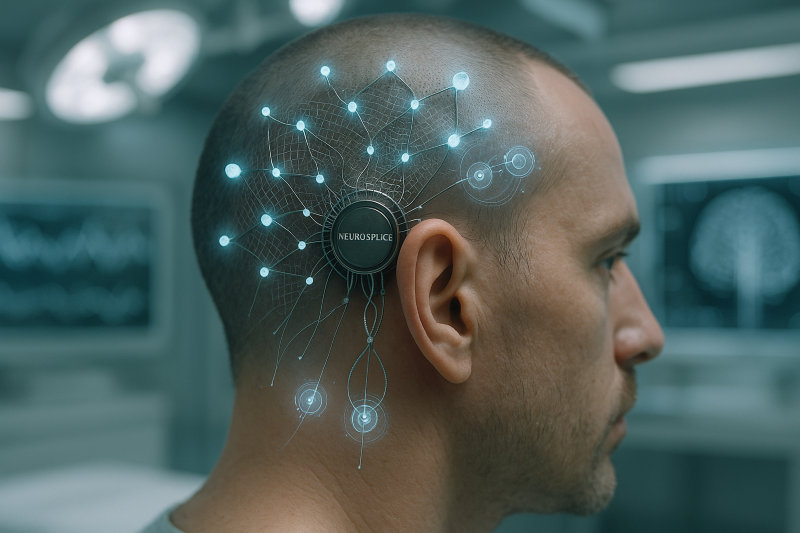
Unlock the untapped potential of your subconscious and reach a new level of control over your dreamscape.
The DreamShare module captures cortical activity during REM sleep. The console at the foot of the bed turns it into images.
The DreamCast module introduces scenes chosen by the physician into the dream, in fragments and at decreasing intensity.
Dream therapies are intended for treatment-resistant post-traumatic stress, disabling phobias, complicated grief, and treatment-resistant depression.
Injection is limited to twelve minutes per REM cycle. A safety system shuts it down in the event of a loop.
From the screening visit to your first recorded night.
After a full assessment at the center (MRI, EEG, sleep recording), the device is implanted under general anesthesia. The procedure takes about three hours. The housing sits behind the ear.
For forty-eight hours, the onboard artificial intelligence learns your sleep signature.
Recordings take place at night, from 10 p.m. to 4 a.m. The study physician schedules the injection sessions, never more than twelve minutes per cycle.
>Implant initialization, revision 2.1 β... OK
>Encrypted link to clinical console (TLS-Q13)... OK
>ECoG array, 256 channels... OK
>Implant/console latency: 38 ms
>Anti-loop watchdog (0x7E)... ACTIVE
>Subject: awaiting enrollment
>_
The first results are in.
Pilot cohort (48 patients): 41% average reduction in post-traumatic symptoms at six weeks.
Testimonials from patients in the pilot cohort and from study volunteers. First names have been replaced with an initial.
Patient L., 41
Pilot cohort
“I saw the scene from a distance, as if it belonged to someone else. Since then, I’ve been able to talk about it.”
Patient M., 29
Pilot cohort
“I’d been afraid of elevators since grade school. On Tuesday, I rode up to the sixth floor for my appointment. It was only when I stepped out that I realized I’d taken the elevator.”
Volunteer R., 33
Healthy volunteer
“In the morning, the nurse showed me my night on the console. There was my grandmother’s kitchen, with the checkered oilcloth. I hadn’t seen it in twenty years.”
The program selects its volunteers after a full medical assessment and an implant compatibility exam.
Healthy volunteers with a technical background
Developers, engineers, researchers. You will be among the first to see your dreams on a screen.
Sleep disorders
Chronic insomnia, recurring nightmares.
Patients referred by their physician
Treatment-resistant post-traumatic stress, disabling phobia, complicated grief, treatment-resistant depression.
Frequent dreamers
You remember your dreams almost every morning, or you sometimes know you are dreaming while you dream.
Psychiatric disorders
Schizophrenia, dissociative disorders, severe bipolar disorder.
Neurological history
Epilepsy, stroke, head injury within the past eighteen months, neurodegenerative disease.
Anatomy
An existing brain or metal implant. Parietal bone less than six millimeters thick.
Other situations
Pregnancy. Use of non-prescribed psychoactive substances.
Before you apply
After implantation, MRI is contraindicated, whether the implant is active or on standby. CT scans remain possible.
A study physician reviews every application. Participation is compensated: €2,400 at implantation, then €80 per recorded night.
Fictional form. Nothing you enter is sent or stored: the form replies, then clears the fields.
Implantation is performed under general anesthesia and takes about three hours. Some discomfort behind the ear is common for the first few days. It is treated with simple pain relievers.
Yes. Outside the sessions scheduled by the study physician, the NeuroSplice introduces no content into your dreams.
After the pre-screening form, a study physician contacts you. A screening visit takes place at the center in Paris. You sign the consent form there, then you have a seven-day reflection period before implantation.
Infection and hematoma, as with any intracranial surgery. The device also has specific effects: very persistent dreams, confusion on waking. In some volunteers, images can spill over into waking life. The medical team follows every volunteer closely during the first weeks.
Data travels end-to-end encrypted between the implant and the clinical console. It is anonymized by aggregation before any use for research purposes.
You may at any time request that recordings be stopped and that the implant be removed, subject to a favorable surgical opinion.
The safety system shuts down injection as soon as a sequence repeats. The medical team notifies your designated trusted person.
You receive €2,400 at implantation, then €80 per recorded night. This compensation covers the constraints of the study. It is neither a salary nor the price of your data.
Every session is supervised by the medical team of the neuro-interfaces department.
Twelve minutes maximum per REM cycle.
The system shuts down injection as soon as a sequence repeats (code 0x7E).
A medical team can be reached day and night for the entire duration of the study.
Mandatory notices. Investigational device. Streams collected during sessions are stored and reused for the continuous improvement of the models, in accordance with the terms and conditions signed by the patient. Reported effects: persistent dreams, confusion on waking, sense of presence, intrusion of non-prescribed images.